




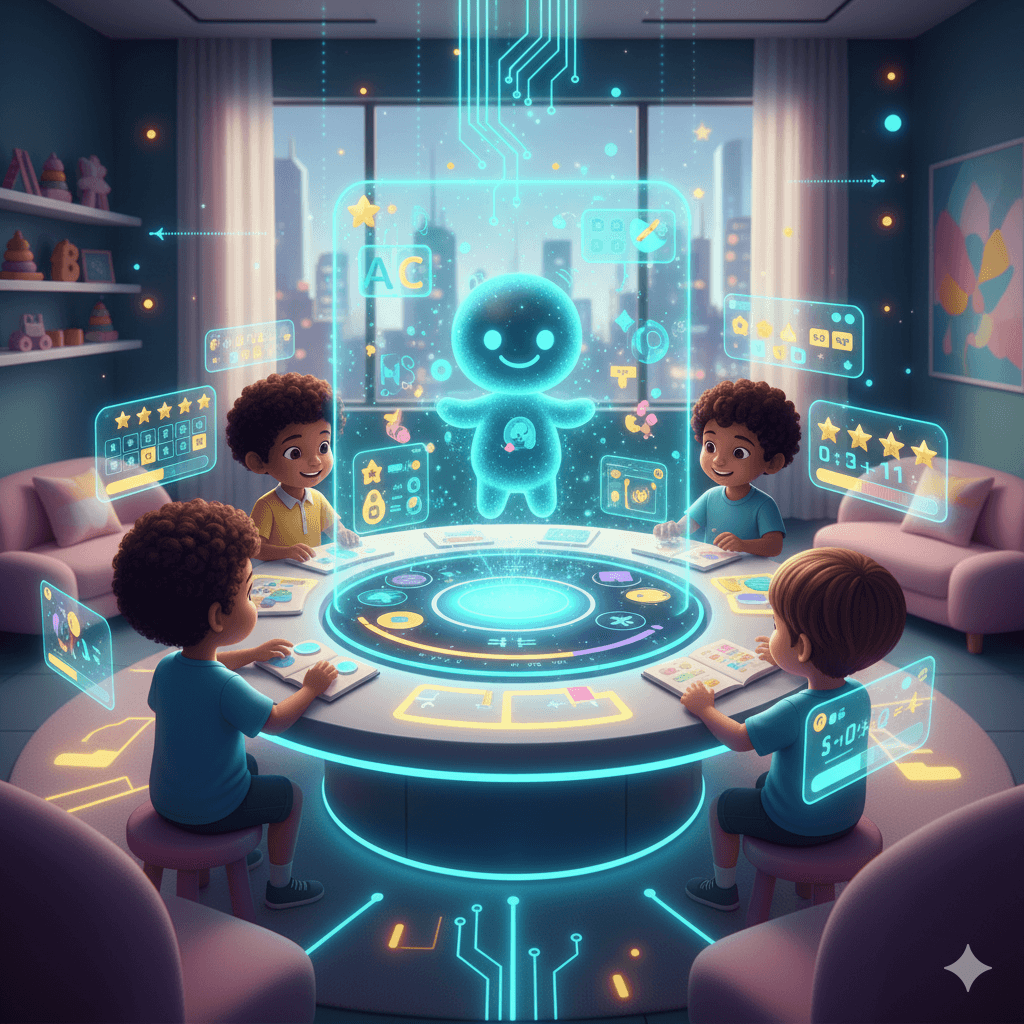
In a world where technology is reshaping how children engage, learn, and grow, AI-powered smart play stands at the front line of innovation. It transforms traditional learning into interactive, adaptive, and deeply personalized experiences—turning every game into an opportunity to learn, explore, and evolve.
What Is AI-Powered Smart Play?
AI-powered smart play refers to learning environments—games, toys, or apps—that use artificial intelligence to analyze how children play and automatically adjust gameplay to their needs.
Unlike standard games, these systems learn from the learner.
More challenge for fast learners
More support for struggling learners
Every child gets a unique pathway that nurtures strengths and strengthens weaknesses.
How AI Personalizes Gameplay & Learning
AI systems track:
- Play patterns
- Response timing
- Preferred difficulty
- Attention span
- Problem-solving speed
Based on these insights, the game:
Adjusts difficulty
Suggests new learning modules
Offers hints or rewards
Recommends next challenges
Learning becomes fluid, dynamic, and child-centered.
Why Personalization Matters
No two kids learn the same way. Some learn visually; some learn by doing.
AI detects these learning signals and adapts in real time.
Benefits
Builds confidence
Maintains engagement
Reduces frustration
Ensures steady progress
Strengthens understanding
AI empowers kids to move at their individual pace, rather than being limited by uniform teaching models.
Core Skills Boosted Through Smart Play
| Skill | Growth Outcome |
|---|---|
| Cognitive Thinking | Better problem-solving |
| Memory Retention | Strong recall |
| Creativity | Strong imagination |
| Reasoning | Logical decision-making |
| Math & Language | Strong foundation |
| Emotional Intelligence | Improved empathy + patience |
Smart play trains the mind while keeping the heart joyful.
Technologies Powering AI-Smart Play
- Machine Learning → Personalization
- NLP (Voice Processing) → Conversations with smart toys
- Reinforcement Learning → Adaptive difficulty
- Computer Vision → Motion-based interactions
- Analytics Engines → Progress dashboards
Together, they create safe, intelligent, and adaptive gaming systems.
Real-world Applications
Home-based Learning
Kids use smart play apps and toys to explore math, language, logic, and creativity.
Classrooms
Teachers integrate smart learning platforms to support lessons and track growth.
Special Needs Support
Adaptive games help children with autism, ADHD & dyslexia develop communication, focus, and interaction skills.
Examples of AI-Smart Play Experiences
Math puzzles that scale difficulty automatically
Story games where characters adapt to player emotions
Smart robots teaching coding through play
Language apps responding to voice inputs
AR games blending physical exploration with digital learning
Learning feels more like adventure than instruction.
Safety & Ethical Design
AI-powered play must prioritize:
Data privacy
Safe content
Screen-time balance
Transparent progress reporting
Parental controls
Smart play is safest when technology is used with care and mindfulness.
The Future: Where Smart Play Is Headed
AI-powered learning is just getting started.
Future trends include:
Emotion-responsive gameplay
Mixed-reality smart classrooms
AI learning companions
Smart toys that evolve with age
Personalized metaverse schools
Tomorrow’s learning will be fluid, immersive—and delightfully smart.